
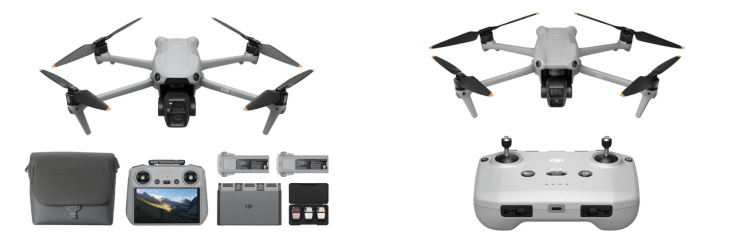
DJI Air 3 vs DJI Air 3S – Check Which One Is Best & Why?

DJI Air 3S & DJI Air 3 share many similarities, but there are also important differences, such as quality, performance, features, design, and connectivity. If you want the best one between them, I Would recommend the DJI Air 3S rather than the DJI Air 3. 

Why Do I Recommend The DJI Air 3S

  • The DJI Air 3S features a 1-inch CMOS wide camera sensor for improved low-light performance and higher image clarity, whereas the DJI Air 3 uses a smaller 1/1.3-inch CMOS sensor.
  • DJI Air 3S supports 4K recording at 120 fps for smoother and more detailed slow-motion footage, while the DJI Air 3 records at a maximum 100 fps.
  • It includes 42 GB internal storage to allow longer 4K recording sessions without relying on SD cards, whereas the DJI Air 3 only comes with 8 GB built-in memory.
  • The DJI Air 3S features an expanded ISO range up to 12,800 for cleaner and brighter results in night or indoor scenes, while the DJI Air 3 is limited to ISO 6,400.
  • DJI Air 3S comes with enhanced obstacle sensing algorithms and LiDAR-assisted detection to improve safety and stability during flights in dim light, while the DJI Air 3 relies only on standard vision sensors.
  • It uses a refined image processing pipeline for higher dynamic range and more accurate color grading, whereas the DJI Air 3 delivers standard processing that recovers fewer details.
  • The DJI Air 3S includes a slightly larger 4276 mAh battery for marginally improved power efficiency and stability under heavier loads, while the DJI Air 3’s 4241 mAh battery.
  • DJI Air 3S integrates optimized video compression for smaller file sizes with minimal quality loss to improve storage management, compared to the DJI Air 3’s standard compression.

Maybe the DJI Air 3 price can make you comfortable because it’s a little bit cheaper than the DJI Air 3S. But you have to compromise all the above-mentioned features. Now the Decision is Yours. I hope it was helpful to choose the right one.

Side By Side Comparison

FeatureDJI Air 3SDJI Air 3
Battery capacity4276 mAh4241 mAh
Wide lens aperturef/1.8f/1.7
Wide FOV~84°~82°
Max video (4K)120 fps100 fps
Video ISO (max)12,8006,400
Internal storage42 GB8 GB
Digital zoom (wide)up to ~2.9×up to ~3×
Color profilesEnhanced HDR/D-Log MD-Log M
Low-light assistImproved processingStandard processing
Obstacle sensingEnhanced omniOmni vision sensing
Night obstacle aidForward assist improvementsVision-only behavior
Transmission tweaksO4 with tuningO4 baseline
File efficiencyHigher compression efficiencyStandard efficiency
PriceCheck DJI Air 3S PriceCheck DJI Air 3 Price

What Common Both Can Do?

  • Dual-camera system: Both drones feature a dual-camera setup combining a wide and telephoto lens, enabling versatile aerial perspectives without needing lens swaps. This setup allows smooth transitions between wide landscapes and close-up shots in a single flight.
  • Telephoto camera (3× optical): Each model includes a 3× optical zoom telephoto camera, providing optical reach without digital quality loss. It’s ideal for isolating subjects or maintaining safe distance while filming.
  • CMOS sensor type: Both drones use CMOS sensors that deliver excellent dynamic range and color reproduction. This sensor technology balances light sensitivity and efficiency for both stills and video.
  • D-Log M color profile: Each model supports DJI’s flat D-Log M color profile for flexible post-production grading. It allows videographers to retain more highlight and shadow detail for cinematic color correction.
  • HDR video support: Both support HDR recording, producing footage with improved contrast and color depth. This ensures more natural, balanced results in scenes with bright and dark regions.
  • 4K recording capability: Both can record up to 4K resolution, ensuring sharp detail for professional-grade video projects. It makes footage suitable for large screens and editing workflows.
  • 1080p recording capability: Each drone supports Full HD video recording for reduced file size and longer storage times. It remains useful for social media and quick editing tasks.
  • OcuSync 4 transmission system: Both rely on DJI’s O4 link, delivering stable 1080p live feeds with low latency at long ranges. This ensures consistent control and video transmission even in signal-heavy environments.
  • Omnidirectional obstacle sensing: Each model employs sensors covering all directions, enabling advanced collision avoidance. This improves flight safety and user confidence in complex environments.
  • Advanced RTH: Both include an intelligent Return-to-Home system that uses obstacle detection and flight path optimization. It automatically plots safer return routes in case of signal loss or low battery.
  • APAS 5.0 system: Each drone includes DJI’s Advanced Pilot Assistance System 5.0 for smoother obstacle bypassing. It helps maintain continuous movement during automated or manual flight paths.
  • ActiveTrack 5.0: Both can follow moving subjects dynamically using AI tracking. This feature ensures steady framing and autonomous subject centering during motion.
  • Waypoint flight: Each drone supports waypoint-based navigation, allowing pre-programmed routes. This ensures consistent results for mapping, cinematic shots, or repeatable flight paths.
  • MasterShots & QuickShots: Both offer automatic flight and recording patterns for creative footage. These modes simplify professional-looking video creation for casual pilots.
  • FocusTrack modes: Each model provides various FocusTrack modes, including Spotlight and Point of Interest. These ensure flexible tracking and framing options without manual camera adjustments.
  • SmartPhoto: Both include SmartPhoto technology that automatically adjusts settings for optimal exposure and detail. It simplifies capturing well-balanced stills in changing light conditions.
  • Panorama capture: Each drone supports panoramic photography to produce wide, immersive landscape shots. The automated capture and stitching make it easy to produce high-resolution panoramas.
  • Hyperlapse mode: Both can record timelapse sequences with motion paths, creating dramatic moving timelapse visuals. This function adds cinematic storytelling capability to flights.
  • RC 2 controller compatibility: Each drone works seamlessly with the DJI RC 2 and RC-N2 controllers. This ensures consistent control experience and long-range connectivity between devices.
  • DJI Fly app control: Both are fully integrated with the DJI Fly app, enabling flight setup, camera control, and editing in one interface. This unifies flight management and creative workflow for users.

Common Features

FeatureDJI Air 3SDJI Air 3
Dual-camera systemYesYes
Telephoto camera (3× optical)YesYes
CMOS sensor typeYesYes
D-Log M color profileYesYes
HDR video supportYesYes
4K recording capabilityYesYes
1080p recording capabilityYesYes
OcuSync 4 transmission systemYesYes
Omnidirectional obstacle sensingYesYes
Advanced RTHYesYes
APAS 5.0 systemYesYes
ActiveTrack 5.0YesYes
Waypoint flightYesYes
MasterShots & QuickShotsYesYes
FocusTrack modesYesYes
SmartPhotoYesYes
Panorama captureYesYes
Hyperlapse modeYesYes
RC 2 controller compatibilityYesYes
DJI Fly app controlYesYes
Price Check DJI Air 3S Price Check DJI Air 3 Price

FAQ

Is the DJI Air 3S a complete replacement for the DJI Air 3?
The DJI Air 3S is not a full replacement but rather an upgraded version of the Air 3. It keeps the same dual-camera system and flight platform while improving low-light performance, internal storage, and video frame rates.

Do both drones have the same flight time?
Flight times are nearly identical, with the DJI Air 3 offering up to 46 minutes and the Air 3S around 45 minutes. The one-minute difference is due to the upgraded sensor and processing system in the Air 3S.

Are the batteries interchangeable between the Air 3 and Air 3S?
Yes, both drones use the same Intelligent Flight Battery, meaning users can swap batteries freely between models without compatibility issues.

Does the DJI Air 3S have the same dual-camera system as the Air 3?
Both drones use a dual-camera setup with a wide and a telephoto lens. However, the Air 3S upgrades the wide camera to a larger 1-inch sensor for better image quality, especially in low light.

Is the image resolution different between the two drones?
The DJI Air 3S captures 50 MP stills from its main 1-inch sensor, while the Air 3 captures 48 MP from a 1/1.3-inch sensor. The difference slightly improves detail and low-light performance on the 3S.

Do both drones record in 4K?
Yes, both support 4K recording, though the Air 3S can shoot at up to 120 fps while the Air 3 maxes out at 100 fps. This gives the 3S smoother slow-motion capabilities.

Do the DJI Air 3S and Air 3 share the same obstacle avoidance system?
Both include omnidirectional obstacle sensing for full 360° protection, but the Air 3S uses improved algorithms and LiDAR-assisted detection for better performance in dim environments.

Are both drones compatible with the same remote controllers?
Yes, both are compatible with the DJI RC 2 and RC-N2 controllers, ensuring consistent control and transmission experience across both models.

Is the transmission range the same on both drones?
Both use DJI’s O4 transmission system, capable of sending 1080p live feeds over long distances. The Air 3S has minor algorithmic tuning for better signal stability, but the overall range is the same.

Do both drones use the same DJI Fly app?
Yes, both are fully integrated with the DJI Fly app for camera control, flight planning, and footage editing. The interface and settings are nearly identical for a seamless transition.

Does the DJI Air 3S have better internal storage than the Air 3?
Yes, the Air 3S includes 42 GB of built-in storage, while the Air 3 only has 8 GB. This allows the 3S to record more 4K footage even without an SD card.

Are both drones capable of ActiveTrack and Waypoint flight?
Yes, both support ActiveTrack 5.0 and waypoint-based flight paths, allowing automatic subject tracking and repeatable preplanned routes.

Do both drones feature HDR and D-Log M recording?
Yes, both models include HDR and D-Log M profiles for cinematic footage. The Air 3S slightly improves highlight and shadow recovery through enhanced processing.

Are both drones designed for similar flight handling?
Yes, the flight dynamics are nearly identical, with smooth, stable control and similar wind resistance levels. Pilots transitioning between the two will experience familiar handling characteristics.

Who should upgrade from the DJI Air 3 to the Air 3S?
Users who often shoot in low light, need higher ISO performance, or prefer larger internal storage will benefit from upgrading to the Air 3S. For daytime or casual flying, the Air 3 remains nearly as capable.

Similar Posts